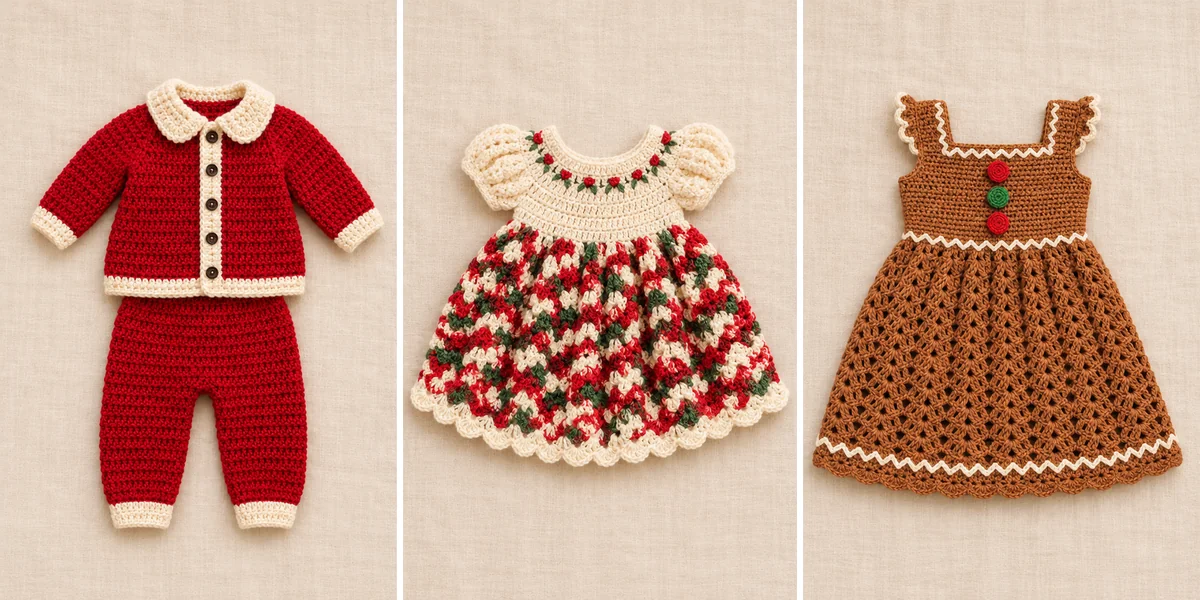
From a red-and-white Santa set to a gingerbread toddler dress, these seven festive crochet projects offer different ways to plan a handmade celebration outfit. Most suit Christmas styling, while the bat costume adds a Halloween option. Choose by the recipient’s measurements, the occasion and the finishing you enjoy, rather than expecting every design to suit a newborn.
The collection includes free written patterns and two free YouTube tutorials. Some designers also offer optional paid PDFs. The snowman cocoon is explicitly a photography prop, and the Gingerbread Girl Dress was written around a toddler-size example. The Quick Picks table highlights those differences.
All images are AI-generated illustrations, not photographs of test-crocheted samples. Use each designer’s original photos and instructions for exact construction. The summaries use US crochet terms; check the source’s stitch key before you begin.
Quick Picks
| Project | Size or planning note | Instructions |
|---|---|---|
| Baby Crochet Santa Outfit | Cardigan and pants; six listed sizes | Free written blog pattern |
| Crochet Christmas Baby Dress | Video-led; confirm supplies and size | Free YouTube tutorial |
| Candy Cane Princess Dress | Video-led; color placement | Free YouTube tutorial |
| Snowman Cocoon and Ear Muff Hat | Newborn cocoon; awake supervised photos only | Free written pattern; photography prop |
| Baby Bat Costume | Halloween; wings and snap-tape assembly | Free written blog pattern; intermediate |
| Crochet Hooded Baby Romper | 3–6 to 9–12 months; bulky yarn | Free written blog pattern |
| Crochet Gingerbread Girl Dress | 2T–3T example; fit-as-you-go notes | Free written blog pattern; toddler example |
Festive Baby and Toddler Outfit Crochet Patterns
1. Baby Crochet Santa Outfit

Laura’s Santa set combines a cardigan with matching pants, making it a fuller gift project than a single dress. The source provides six age-labelled sizes from newborn through 15–18 months. The sweater’s sizing method and the pants’ directions differ, so read both sections before choosing hooks or estimating yarn. The pants use an elastic waistband; check the finished waist and cardigan fit rather than relying on an age label alone.
Source · Laura Brian · Traverse Bay Crochet · Free written blog pattern
2. Crochet Christmas Baby Dress

Choose this video-led project if you prefer to see the dress take shape as you work. The linked tutorial is published by Crochet Cuties. Before buying supplies, check the creator’s yarn, hook, target measurements and stitch explanations in the video. Pause at construction changes and keep a note of your row or round count. Use the video’s own measurements to assess fit rather than estimating from the finished illustration.
Source · Crochet Cuties · @lizzycrochetpatterns2023 · Free YouTube tutorial
3. Candy Cane Princess Dress

An ivory yoke and multicolored skirt give this dress a candy-cane-inspired palette. The linked Bag-O-Day tutorial is titled Candy Cane Princess and numbered 539. Watch the materials and sizing section before starting, and note where color changes happen so you can pause without losing your place. Confirm the intended size using the tutorial’s own measurements before starting.
Source · Bag-O-Day Crochet · Free YouTube tutorial
4. Snowman Cocoon and Ear Muff Hat

Sarah explicitly describes this set as a photo prop. The white body uses chunky category 5 yarn, with worsted-weight yarn for the contrast details; using only worsted yarn will change the result. The cocoon instructions are for a newborn, while the hat has separate size options. Use only for an awake baby under direct adult supervision, remove before sleep, and check every decoration. The illustration uses flat crochet circles instead of hard buttons.
Source · Sarah Zimmerman · Repeat Crafter Me · Free written pattern; photography prop
5. Baby Bat Costume

This Halloween costume adds a different celebration to the collection. Amanda rates it intermediate, with a onesie in 6- and 12-month versions and a separate hat. Plan for assembly as well as crochet: the wings attach to the body, and snap tape is used for closures. Read the shaping and joining notes first, then check the shoulder and crotch openings before sewing the tape permanently.
Source · Amanda Saladin · love. life. yarn. · Free written blog pattern; intermediate
6. Crochet Hooded Baby Romper

The source calls this garment a snowsuit, jumpsuit or romper. Here it is presented as a crocheted hooded one-piece, without a claim that it is weatherproof or tested winter outerwear. Millie’s free pattern lists three sizes from 3–6 to 9–12 months and uses bulky yarn with a 6 mm hook. Compare the body, sleeve and leg measurements before adding length, and include the hood and button band in your yarn planning.
Source · Millie Anderson · Swecraftcorner · Free written blog pattern
7. Crochet Gingerbread Girl Dress

This entry is for a toddler, not a newborn. Sarah made the original to fit her two-year-old in a 2T–3T size and notes that the written counts were not double-checked. The design combines a V-stitch skirt with a single crochet bodice, worked from the bottom up. Adjusting skirt length alone will not resize the chest, armholes or straps; measure those areas separately as you work.
Source · Sarah Zimmerman · Repeat Crafter Me · Free written blog pattern; toddler example
Choose the Size and Plan the Finishing
Compare the recipient’s measurements with the source’s finished chest, length and opening measurements, then make the recommended gauge swatch. Age labels vary between designers. A longer skirt does not automatically create a larger bodice, and longer legs do not adjust the body length of a romper.
Read the entire pattern or watch the relevant video sections before starting. Set aside yarn for collars, cuffs, wings and edging as well as the main fabric. For video projects, write down the stitch abbreviations, row or round where you stop, and any size-specific changes. Add assembly and weaving-in time to your plans without relying on a promised completion time.
Costumes, Photo Props and Baby Sleep
Use the snowman cocoon only for an awake baby under direct adult supervision, following the designer’s photo-prop guidance. Remove it before sleep. Check buttons, snap tape, ties and decorations regularly, and stop using an item if a part becomes loose. A flat embroidered detail can reduce the number of separate decorative pieces, but it does not make a costume safety-tested.
These patterns should not be presented as approved sleepwear or sleep sacks. Keep a baby’s head and face uncovered during sleep and avoid overheating. Health Canada’s guidance on dressing babies for sleep explains that daywear with hoods, straps or other parts can create hazards during unsupervised sleep and advises removing outerwear indoors.
Care and Gift Preparation
Follow the yarn label and any trim-specific washing instructions. Check seams and fasteners after washing, shape the garment gently, and let it dry completely before wrapping. Include a care note and the source’s size information. For a photo prop, label its intended use clearly so the recipient does not mistake it for everyday sleepwear.